“All in the Family” at Charter Broker Aerodynamics
Aerodynamics has been providing private jet travel for many years, ranging from business travel to transporting sports teams and private events. Although the company has not been hit as hard by the pandemic as major airlines, it has still felt the effects of the crisis.
Aerodynamics has been operating ad hoc charter flights for Transavia since January 1, 2019. These are tailor-made flights for companies or private individuals, using a Transavia aircraft to a destination of their choice. On behalf of Transavia, Aerodynamics is responsible for both the sales and the commercial handling of these flights.
On a quiet winter day at Schiphol-East, only a handful of aircraft are parked on the business aviation platform. At the Aerodynamics office, overlooking the Oostbaan runway, the two owners, Huyb van Monsjou and Jan Roosjen, sit together with sales manager Ronald Wüstefeld.
“It’s much quieter than before,” notes Huyb van Monsjou. “For example, you don’t see any American aircraft here anymore. They’ve stopped crossing the Atlantic since the virus outbreak.” Nearby, a long row of Boeing 737s belonging to partner Transavia stands idle, as demand for tickets has dropped significantly.
Van Monsjou, Wüstefeld, and Roosjen reflect on the state of the industry and the shift the pandemic has caused since last spring.
“Our Transavia charters used to be daily business,” says Van Monsjou. “Now, very little is happening.”
Roosjen adds: “The only significant transport we still handle involves football teams and the relocation of ship crews.”
All in the Family
To better understand Aerodynamics, it helps to look back to the period before the pandemic. In 1986, Huyb van Monsjou founded the company with the aim of serving the business market. Jan Roosjen joined in 1991 and became co-owner. Ronald Wüstefeld joined in 2001 as sales manager and has remained with the company ever since.
“We operate flights of a very diverse nature,” says Van Monsjou. “With more than 34 years of experience, Aerodynamics is the Netherlands’ first broker. Our specialization is broad: from small-scale aviation to transporting large groups for global sporting events.”
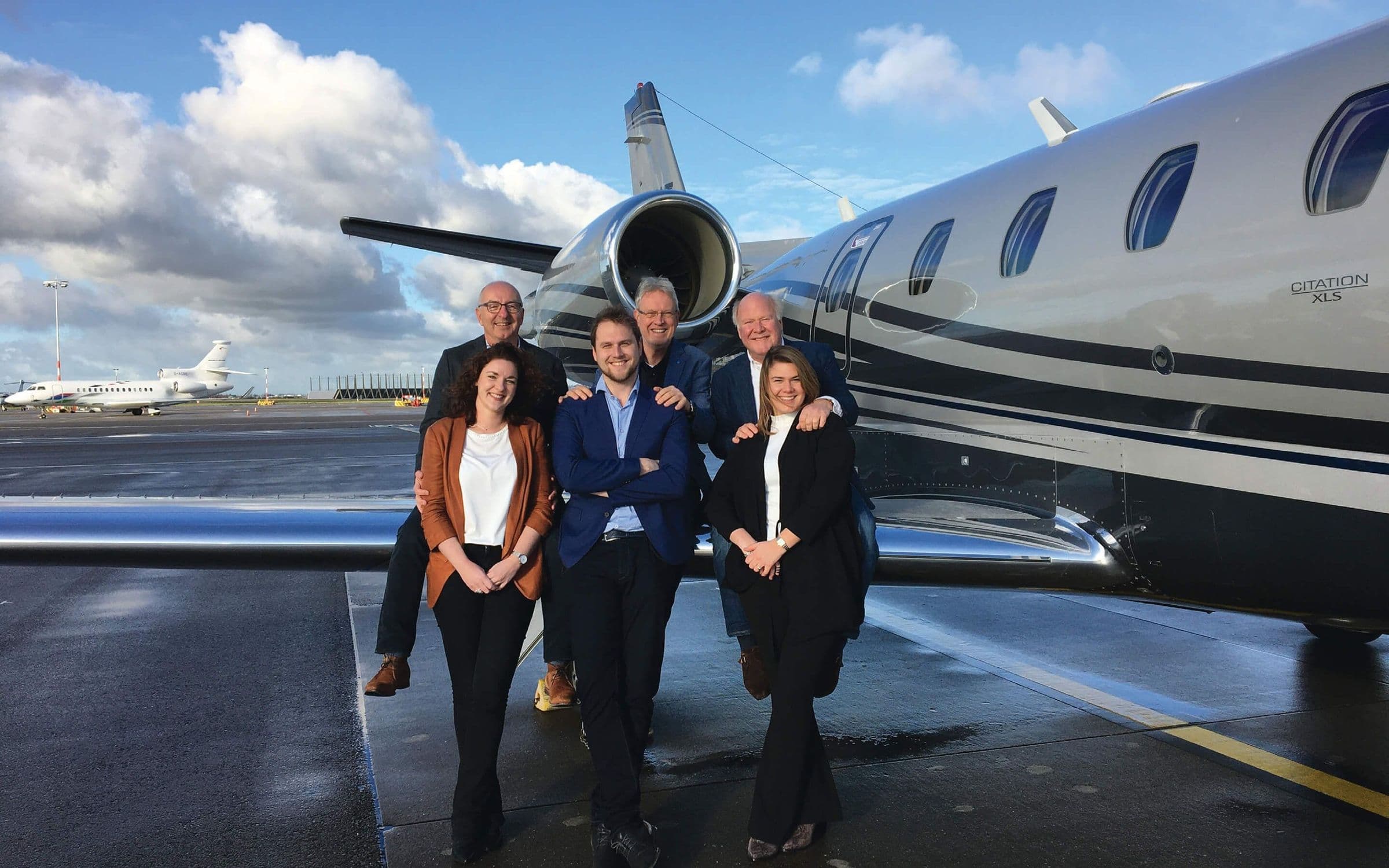
Since 2017, Aerodynamics has become a true family business with the arrival of the next generation. Three members of the second generation — Sophie van Monsjou, David Roosjen, and Roos Wüstefeld — have joined the company, following in their fathers’ footsteps.
Roos Wüstefeld focuses on the business jet market, while David Roosjen and Sophie van Monsjou are primarily responsible for Transavia’s ad hoc division.
All members of the team are fully qualified brokers,
says Van Monsjou
Transavia
What does the partnership with Transavia involve?
Since January 1, 2019, Aerodynamics has been organizing ad hoc charter flights for the KLM subsidiary.
“These are tailor-made flights for companies or private individuals, using a Transavia aircraft to a destination of their choice,” explains Jan Roosjen. “Aerodynamics handles both the sales and the commercial responsibility for these flights on behalf of Transavia.”
These flights are sold using Transavia’s remaining capacity — aircraft that are not deployed for scheduled or charter services, adds Van Monsjou.
“These flights can be booked by both businesses and private individuals, for example for travel to trade fairs, conferences, or sporting events. It is also possible to charter an entire aircraft for a corporate or family event abroad.”
Transavia has operated charter flights since 1967 and later expanded into scheduled services. Over time, due to market changes, scheduled flights became the dominant focus. With less remaining capacity and slot restrictions in the Netherlands, Transavia was no longer able to operate as many charter flights as before, turning it into more of a secondary activity. The airline, recognizable by its green livery, was therefore pleased that Aerodynamics, located just nearby, could take over this market segment.
Wet Lease and Private Jet Management
Aerodynamics does not own its own fleet but instead uses privately owned aircraft, which are leased on a wet lease basis (including crew). These range from smaller aircraft to large types capable of transporting between four and five hundred passengers.
Under the name Aircraft Management Schiphol, Aerodynamics also offers services related to the acquisition of private jets.
“We have years of experience guiding clients through the purchase process and professionally managing flight operations,” says Ronald Wüstefeld. “From the initial acquisition to the commercial operation of the aircraft.”
The company currently manages two private jets of the type Cessna Citation XLS, which can accommodate up to nine passengers.
Convenient, Safe, and Cost-Effective
Why would a business traveler choose a private jet over business class on a commercial airline?
“If it concerns a business group, a private jet is often more convenient,” says Wüstefeld. “Not only can more destinations be reached than with scheduled services, but the flight schedule can also be determined independently of fixed departure times. Travelers can even hold meetings during the flight.”
There is also an additional advantage in the current pandemic era, adds
Traveling by private jet means traveling in a private space, which significantly reduces exposure due to the limited number of people on board.
Roosjen
The directors emphasize that private individuals can also charter a jet.
“If you travel with multiple people, it can be financially very attractive compared to business class on a scheduled flight,” says Van Monsjou.
Empty Legs
Another service offered by Aerodynamics is so-called “empty legs.”
“An empty leg is a flight that would otherwise operate without passengers because the aircraft needs to be repositioned,” explains Wüstefeld. “We can offer these at significantly reduced prices, sometimes up to 50% lower than the standard rate.”
These flights are offered regularly, although there are some conditions:
Travelling by private jet means travelling in a private space in terms of infection risk, given the limited number of people on board.
“It’s always a one-way trip with a fixed schedule, meaning the traveler must adapt to the flight timing. Empty legs are typically announced only a few days before departure, and the aircraft type may vary in terms of luxury and service.”
Cargo Transport
Aerodynamics brokers also arrange cargo transport, organizing freight capacity on airlines such as KLM and Emirates.
“Cargo transport is always tailored,” says Roosjen. “Sometimes speed is critical, while in other cases we look for the most cost-efficient solution.”
He gives a recent example:
“We recently chartered a Boeing 747 full freighter from Emirates to transport ship components from Dubai to Durban. Around 110 tonnes of cargo were flown to the South African port, where the parts were installed on a vessel. Among the shipment were four steel components weighing 12,000 kilograms each. Normally, such cargo would be transported by sea, but for this important project, air freight was the most efficient solution — and we made it happen.”
Dangerous Goods
A specialized branch of cargo transport involves dangerous goods.
“In these cases, using a private jet is often essential, as it allows for faster and more flexible delivery,” says Van Monsjou. “Aerodynamics has years of experience in deploying aircraft effectively to ensure that goods arrive at the right place at the right time.”
The most commonly used aircraft for such missions is the Cessna Citation CJ1.
“We regularly transport radioactive medical isotopes in this way.”

